Board and Staff Facilitation
A retreat is worth what survives it.
Organizations call a retreat when something needs to be decided, repaired, or agreed — and then design an agenda full of activities that avoid deciding anything. Everyone leaves energized. Within a month the same question is still open.
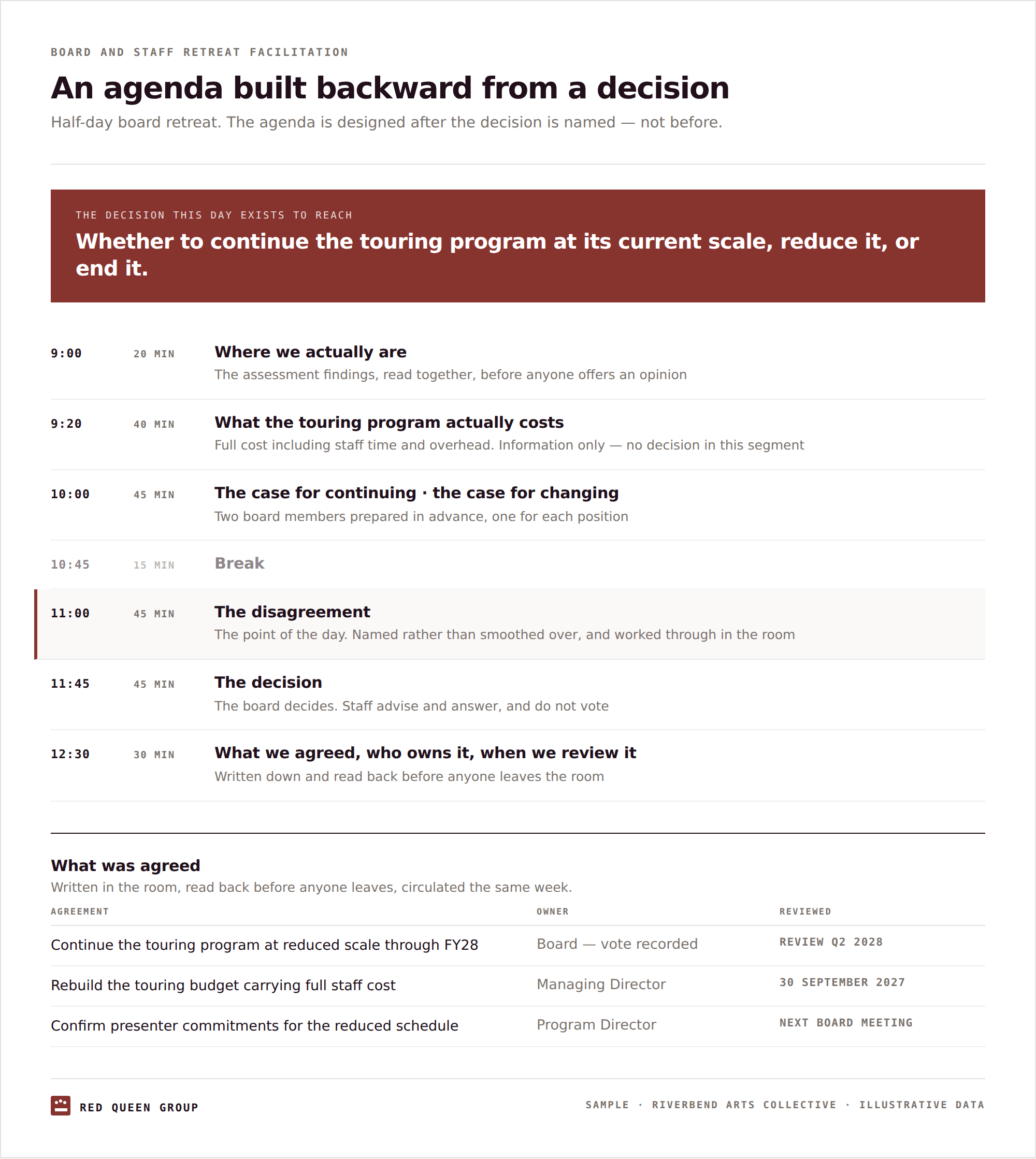
Facilitation here begins from the opposite end. The first conversation establishes what has to be different when the day is over: a decision reached, a conflict named and addressed, a set of priorities agreed, a plan whose lines each person has personally committed to. The agenda is then designed backward from that outcome, and the pre-work is designed to make sure the room arrives ready to do it.
An outside facilitator is not brought in for neutrality alone. A facilitator holds the harder part of the day — the point where the discussion reaches the real disagreement and the group's instinct is to move on. That is usually the moment the retreat was called for.
Retreats are designed for boards, for staff, or for both together, and the choice matters more than it appears. Sessions commonly cover strategic priorities, board development and composition, the working relationship between board and staff, program direction, and the translation of a plan into assigned and scheduled work.
Every session ends with what was agreed, who owns it, and when it will be reviewed — in writing, circulated afterward. Without that, a retreat is a good day that leaves no record.