
Your Custom Text Here
Executive Search and Transition
A leadership transition is the most consequential thing a board will do. It is also the thing most boards do least often.
Executive transition carries risk in the best circumstances and considerably more when a founder or long-tenured leader is departing. What the research shows is that the risk sits in how the transition is prepared rather than in who is eventually hired. In one study of nonprofits moving through executive transition, half of the organizations that used interim staffing alone (four of eight) were struggling or had already lost their new executive, against three of twenty among those that had also done the organizational work first. The samples were small and the study is now dated, but the finding is consistent with what is witnessed in practice: searches fail where the board and the incoming executive never established what success in the first year would look like.
The work is therefore built to front-load that agreement, not to accelerate the hire.
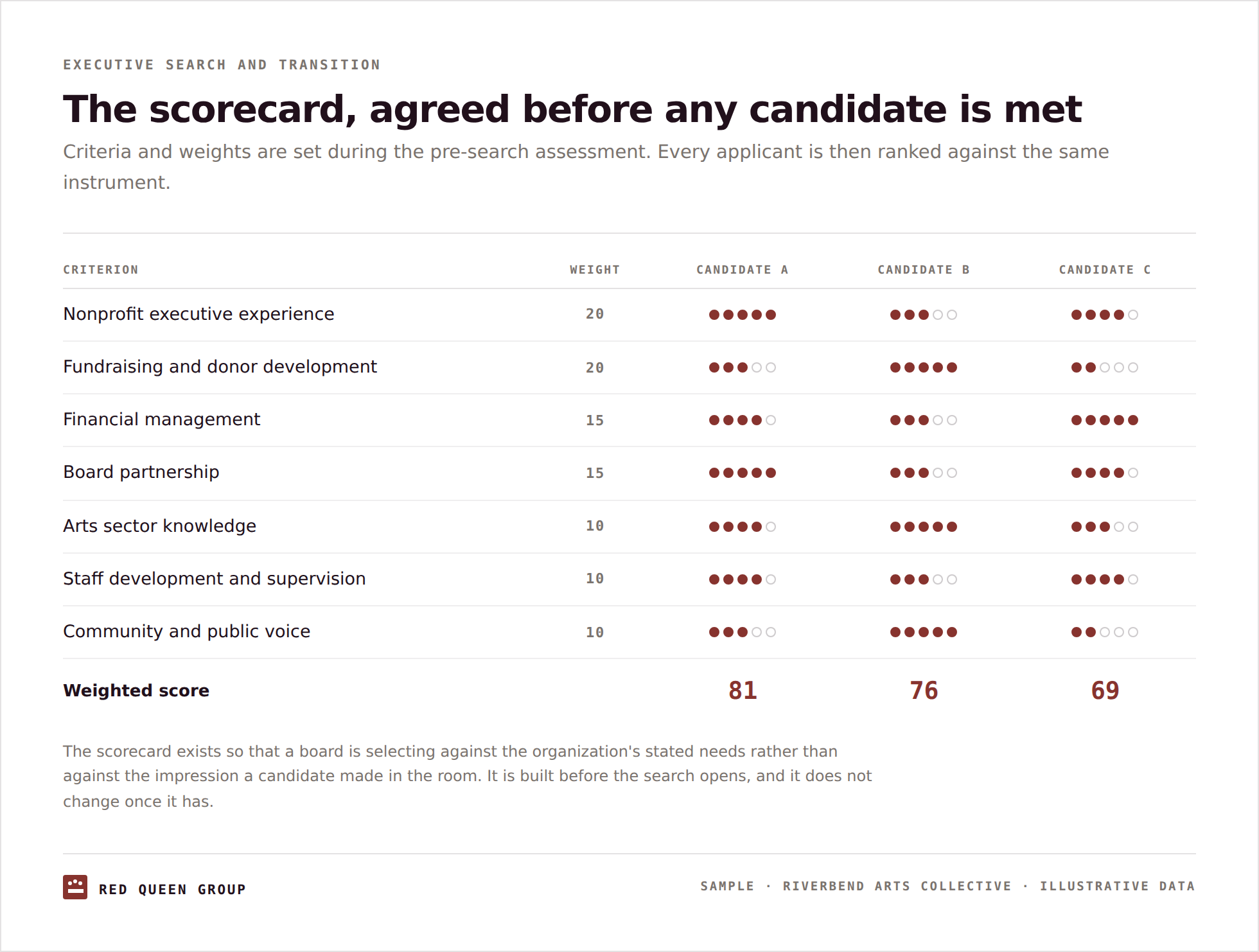
Before the search. Interviews with board, staff, and key stakeholders establish what the organization actually needs in its next leader. That produces three documents rather than one: a position description, a scorecard against which every candidate is ranked, and a set of strategic priorities the incoming executive is expected to address in the first twelve to eighteen months. The priorities document later becomes the basis for the letter of agreement and the performance evaluation. A compensation analysis of comparable organizations prepares the board for the negotiation before it begins.
The search itself combines posted recruitment with active recruitment through professional networks built over three decades in the sector — which is still where the strongest candidates are found.
After the hire, optional onboarding establishes how the board and the new executive will communicate, what will be reported, and when performance will be formally reviewed.
One caution shapes every engagement: where an organization's stability is in question, it is not recommended that it proceed to hire a permanent executive until substantial progress has been made. Recruiting new leadership into an unresolved problem sets that leadership up to fail.