
Your Custom Text Here
Strategic Planning
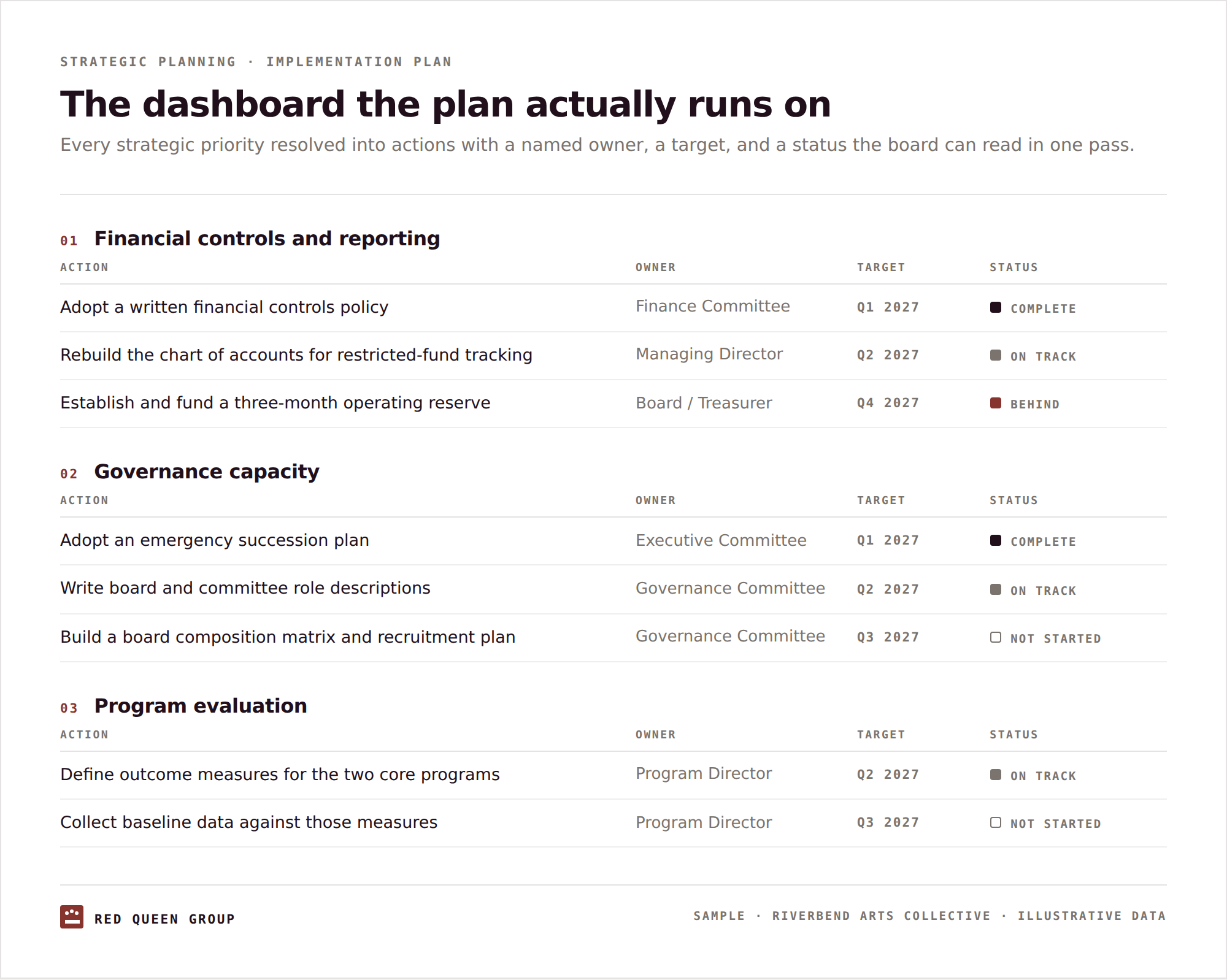
It is one thing to write a plan, but quite another to implement it.
Most strategic plans fail in the same way. They are written before the questions are answered, adopted by a board that was not part of building them, and handed to a staff who had no role in setting the commitments they are now expected to meet. The document is finished and the work never starts.
Planning here is built in the reverse order. It begins with assessment, because priorities set without evidence are guesswork with a timeline attached. The leadership then works through the findings to reach genuine agreement on a small number of strategic priorities — not a list of everything worth doing, but the few things that will be done.
Only then does the plan take shape. Each priority is developed in facilitated working sessions with the people who will carry it, into action items with benchmarks, indicators of success, timelines, and a named party responsible for each. The result is an implementation plan — a dashboard the organization actually runs on, rather than a document it files.
A strategic plan should be a living document, open to update, modification, and expansion as conditions change. Dates in it are planning targets, not promises. What matters is that the organization returns to the plan on a schedule, confirms or adjusts what lies ahead, and can answer at any point what has moved and what has not.
Built in this order, it is a plan the staff owns and the board can fund.